
Top Software Development Types Every Business Should Know
Many business owners and executives are still asking, what are the types of software development, and how do they apply to their specific growth stage? Understanding the different software development types is very vital before investing capital into any technology initiative.
From startups building their first product to established enterprises upgrading legacy systems, haveing some knowledge of the right software development types can determine whether your project scales successfully or becomes a costly mistake. Many business owners also wonder how many types of software engineering are there, and which of them truly align with business objectives rather than just technical trends.
Let’s break down the major types of software with explanation, helping Nigerian business owners, managers, and C-suite executives clearly understand what are the types of software development available, and more importantly, when their businesses actually need them. By mastering these software development types, you can make informed decisions that support long term business growth.
What Are Software Development Types?
Simply put, software development types refer to the different categories of software solutions and approaches used to design, build, deploy, and maintain systems that solve business problems.
When executives ask, what are the types of software development, they are usually referring to two major perspectives, the type of software being built and the approach used to build it. This is where understanding types of software with explanation becomes important. For example, businesses may choose between web applications, mobile applications, enterprise systems, SaaS platforms, or custom built solutions depending on their operational needs.
Equally important are software development model types, which define how the software is created. These include Agile, Waterfall, Scrum, and other different types of software development models that determine timelines, flexibility, risk management, and collaboration style.
By clearly understanding these software development types and the different types of software development models available, Nigerian business owners and C-suite leaders can align technology decisions with growth strategy, budget, and revenue generation.
Major Software Development Types Every Business Should Know
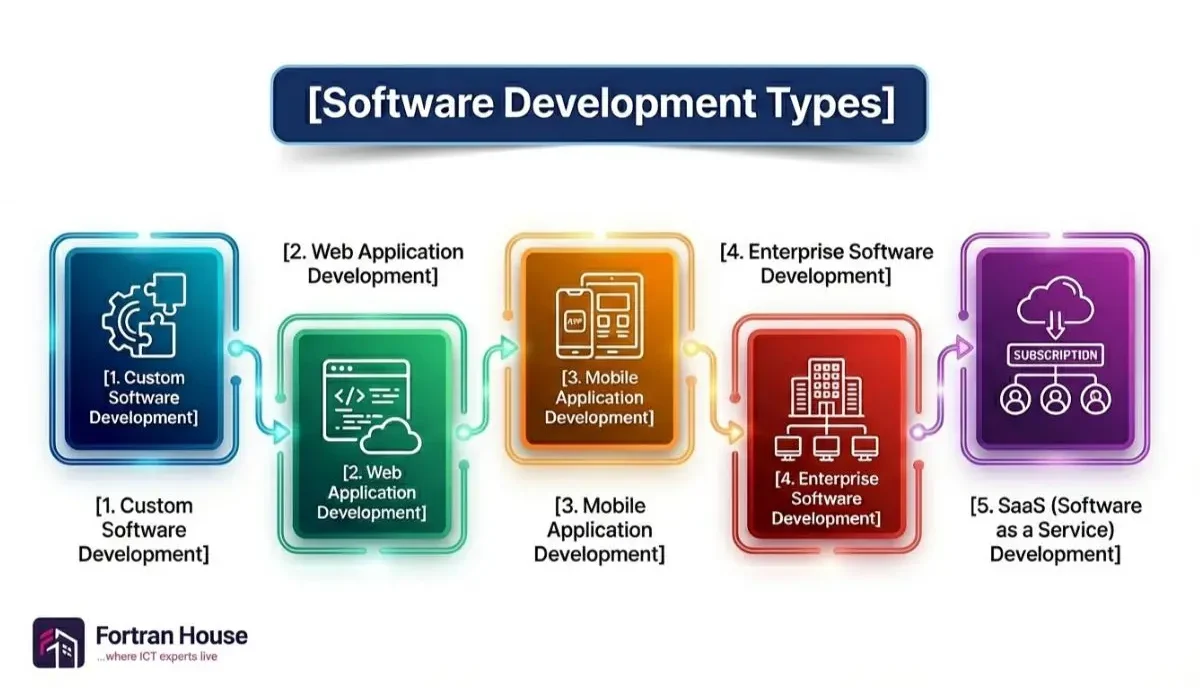
1. Custom Software Development
Among the most strategic software development types, custom software development stands out for businesses that need tailored solutions rather than generic, off-the-shelf tools. Unlike ready made applications, custom systems are built specifically around a company’s workflows, goals, and scalability plans.
There are various types of custom software development, including enterprise resource planning systems, customer relationship management platforms, booking systems, fintech applications, and industry specific operational software. These software development types are ideal for Nigerian businesses that want full control, stronger security, and long term competitive advantage.
However, the success of custom solutions largely depends on choosing the right partner from the many types of software development companies available. Some firms specialize in startups and MVPs, while others focus on enterprise scale architecture and digital transformation. With Fortran House, you get full rounded custom software development that aligns perfectly with your business.
2. Web Application Development
Website app development has become one of the most practical solutions for Nigerian businesses seeking accessibility, scalability, and cost efficiency. Unlike traditional desktop software, web based application development allows companies to run their systems directly through browsers, making it easier for teams, customers, and stakeholders to access platforms from anywhere.
With the rise of remote work and multi location operations, web mobile application development is increasingly important. Businesses now require systems that function perfectly across desktops, tablets, and smartphones without building separate platforms from scratch. This is where choosing the right web application development frameworks becomes critical, as frameworks determine performance and security.
Today, modern web application development goes beyond static websites. It includes dynamic portals, enterprise dashboards, SaaS platforms, CRM systems, and custom operational tools that drive efficiency and revenue growth. For business owners and managers, investing in structured website app development ensures flexibility, faster updates, and improved digital infrastructure.
3. Mobile Application Development
Mobile application development has become a core part of most businesses when targeting growth, customer engagement, and operational efficiency. From fintech and logistics to healthcare, hospitality, retail, fashion, etc. Nigerian companies are leveraging mobile apps to reach users directly on their smartphones.
Successful mobile application development starts with choosing the right mobile application development platforms, whether native (Android or iOS) or cross platform solutions. The decision impacts performance, scalability, and long term maintenance. Working with experienced mobile application development vendors such as Fortran House, who understand local market realities, user behavior, and regulatory considerations, is key to building the perfect Mobile application development for your business.
A well defined mobile application development roadmap ensures your app moves strategically from idea validation to design, development, testing, launch, and continuous improvement. It also helps business leaders clearly understand the mobile application development cost, avoiding budget overruns and hidden expenses.
For Nigerian businesses seeking reliable execution, Fortran House stands out as a trusted partner. With deep technical expertise, structured project planning, and a focus on scalable architecture, Fortran House provides end-to-end mobile application development services, helping business owners and managers build secure, high performing apps that drive measurable growth.
4. Enterprise Software Development
As organizations scale, basic tools are no longer sufficient to manage operations across departments, locations, and large teams. This is where enterprise software development becomes essential. Unlike small business applications, enterprise systems are designed to handle complex workflows, high user volumes, and data security requirements.
Through structured enterprise application development services, businesses can integrate finance, HR, inventory, CRM, and reporting into one unified system. Many growing companies also require enterprise web software development to ensure their platforms are accessible across branches and devices, enabling effective collaboration and decision making.
For corporations seeking custom software development for enterprise, it is critical to work with experienced partners, not just generic mobile application development vendors offering limited solutions. Enterprise systems demand strategic architecture, security compliance, and scalable infrastructure.
This is where Fortran House stands out. As a leading Nigerian software development company, Fortran House delivers tailored enterprise software development solutions designed to support expansion, automation, and digital transformation. With deep expertise in enterprise application development services and enterprise web software development, they help business owners and business managers build secure and scalable systems.
5. SaaS (Software as a Service) Development
Amongst the many modern software development types we have out here, saas development has become one of the most profitable and scalable models for businesses. Instead of selling one time software licenses, companies can build subscription based platforms that generate recurring revenue and serve customers globally.
Successful saas application development requires more than just coding. It involves multi tenant architecture, cloud infrastructure, strong security controls, and smooth user experience. Businesses investing in saas product development must ensure their platform is reliable, scalable, and designed for continuous updates. This is why choosing the right provider such as Fortran House for saas application development services is critical.
Working with an experienced saas application development company ensures your product is built with performance, security, and scalability in mind from day one. In Nigeria, organizations launching SaaS platforms need both technical expertise and strategic business insight.
This is where Fortran House is your go to solution. As a trusted software partner, Fortran House delivers structured Saas development solutions tailored to startups, enterprises, and investors looking to build scalable SaaS platforms. From strategy and architecture to deployment and optimization, we provide end-to-end saas application development services that position businesses revenue and profit maximization.
Types Of Software Developers And Their Roles In Your Project
Understanding the types of software developers involved in a project is just as important as choosing the right software solution. Different types of developers in software handle specific responsibilities, and the success of your system depends on how well these experts collaborate.
For business owners, business managers, and C-suite leaders, knowing the various types of developers ensures you hire a complete, well balanced team rather than a single coder trying to do everything.
1. Frontend Developers
Frontend developers are responsible for everything users see and interact with. Among the key types of software developers, they focus on design implementation, responsiveness, and user interface functionality. These types of developers in software ensure your platform is visually appealing, intuitive, and optimized across devices.
2. Backend Developers
Backend developers handle the server, database, and core application logic. These types of developers ensure your system processes data securely, integrates with other tools, and performs efficiently under high traffic. Without this category of types of software developers, even the best looking application would fail operationally.
3. Full-Stack Developers
Full-stack developers combine both frontend and backend capabilities. Among the flexible types of developers in software, they can manage complete workflows, making them valuable for startups and mid-sized projects that require versatility across development layers.
4. DevOps Engineers
DevOps engineers focus on deployment, infrastructure, automation, and system reliability. These specialized types of software developers ensure continuous integration, faster releases, and secure cloud environments. For scaling businesses, these types of developers are critical to maintaining performance and uptime.
5. QA Engineers
Quality Assurance (QA) engineers are responsible for testing and validating the product before launch. Among the essential types of developers in software, they identify bugs, security gaps, and performance issues, protecting your investment from costly failures.
6. UI/UX Designers
Although not always categorized strictly as developers, UI/UX designers work closely with different types of software developers to craft better visuals and user experiences. These types of developers focus on research, user behavior analysis, and interface structure to ensure the product meets business goals and user expectations.
For Nigerian businesses seeking a complete development partner, Fortran House provides access to all major types of software developers under one roof. Instead of outsourcing fragmented roles, you gain a coordinated team of frontend experts, backend engineers, full-stack developers, DevOps specialists, QA professionals, and UI/UX designers, all aligned to deliver scalable, secure, and high performing software solutions for your business.
By partnering with a full-service company like Fortran House that understands the different types of developers in software, your project benefits from structured collaboration, technical excellence, and long term strategic support.
Conclusion
Understanding the right software development types is not just for technical purposes, it is a strategic business move. From custom systems and enterprise platforms to mobile apps and SaaS solutions, choosing the appropriate software development types determines how efficiently your organization operates, scales, and competes in Nigeria’s market.
For business owners, executives, and stakeholders, mastering these software development types ensures that your software investments align with growth stage, budget, and long term objectives. Rather than adopting technology blindly, informed business owners and managers can evaluate the most suitable software development types based on operational needs, scalability goals, and market expansion plans.