

What Is Software Development? A Complete Guide for Business Owners
Before now Software development used to be reserved for tech startups alone, but guess what? Software development has now become a strategic and necessary factor for businesses that want to scale, compete, and remain relevant in every industry.

Across Nigeria, companies in retail, hospitality, finance, logistics, healthcare, and professional services are embracing software development for business to automate operations, improve customer experience, and increase profitability.
Why Every Nigerian Business Must Understand Software Development
Nigeria’s business landscape is rapidly digitizing. From SMEs in Lagos to large corporations in Abuja and Port Harcourt, etc. Organizations are moving away from manual processes, spreadsheets, and disconnected systems toward integrated digital solutions.
This has fueled the rise of software companies in Nigeria that build tailored systems to help businesses manage sales, operations, finance, and customer relationships more efficiently. Be it a custom CRM, accounting system, inventory management platform, or enterprise dashboard, software is now at the center of business growth.
Software Development Definition
Software development refers to the structured process of designing, building, testing, deploying, and maintaining digital applications that solve specific problems. For business owners, however, the software development meaning goes beyond coding, it is about creating systems that improve efficiency, automate operations, and generate measurable business value.
In simple terms, software development is the process of turning business ideas, workflows, and operational needs into functional digital tools. These tools may help you manage customers, track finances, monitor inventory, analyze performance data, or streamline internal communication. It is not just about writing lines of code, it is about translating business strategy into scalable technology solutions.
To better understand this concept, you’d have to consider practical software development examples relevant to Nigerian businesses:
- A custom CRM platform that tracks leads and automates follow-ups.
- A hotel management system handling bookings, payments, and reporting.
- An accounting solution tailored to local tax regulations.
- A logistics tracking dashboard for delivery companies.
- An internal HR portal for staff management and payroll processing.
Each of these examples demonstrates how software is built around a business objective, for purposes of increasing revenue, reducing costs, improving transparency, or enhancing customer experience.
Understanding the different software development types also helps business leaders make informed decisions. While some businesses require web based platforms accessible through browsers, others may need mobile applications, enterprise systems, cloud-based SaaS platforms, or AI-powered solutions. The type of software chosen depends on your business model, operational complexity, growth stage, and long-term digital strategy.
For executives and stakeholders, the key takeaway is this, software development is not merely a technical activity handled by programmers. It is a strategic investment that transforms business processes into intelligent, automated systems designed for growth and scalability.
Importance Of Software Development For Businesses
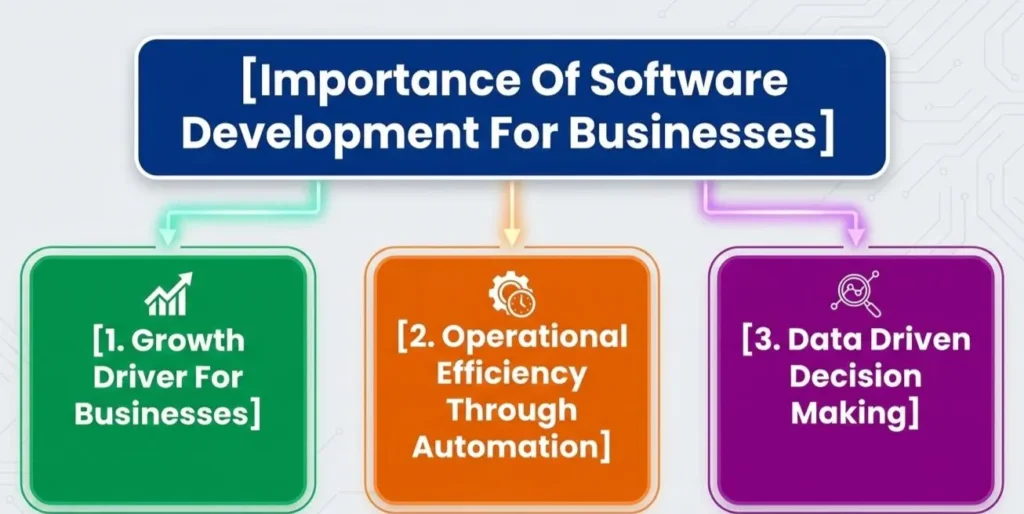
1. Growth Driver For Businesses
Software development for business has become a growth driver both SMEs and big corporations. Businesses that embrace custom digital solutions operate faster, make smarter decisions, reduce waste, and deliver better customer experiences. Those that rely solely on manual systems often struggle with inefficiencies, data errors, slow reporting, and limited scalability.
At a strategic level, software development enables businesses to:
- Automate repetitive processes
- Improve operational visibility
- Centralize data across departments
- Enhance customer engagement
- Increase revenue through better decision-making
If you run a retail company, manufacturing firm, logistics operation, hotel, healthcare facility, or financial service organization, software helps you transition from reactive management to proactive and data driven leadership.
2. Operational Efficiency Through Automation
Many businesses still rely on spreadsheets, paper records, or disconnected systems. Custom-built software solutions eliminate these bottlenecks. For example, software for inventory management allows retailers and distributors to:
- Track stock levels in real-time
- Automate low stock alerts
- Reduce shrinkage and wastage
- Manage multi-branch inventory seamlessly
Instead of discovering shortages after losing sales, businesses gain predictive visibility and tighter control over stock movement.
3. Data Driven Decision Making
Modern leadership depends on actionable insights. Software for data analysis empowers executives to:
- Monitor revenue trends
- Track customer behavior
- Measure team performance
- Forecast demand
- Identify cost leakages
Rather than relying on assumptions, managers can use dashboards and analytics tools to guide pricing, marketing, procurement, and expansion strategies.
This is where software development for business becomes transformational, as it turns raw operational data into strategic intelligence.
How Businesses In Lagos, Abuja And Top States Are Leveraging Softwares
Across Lagos, Nigeria’s commercial capital, businesses are rapidly investing in automation and enterprise systems. Retail chains are implementing software for inventory management to handle multi location stock. Fintech companies are building scalable platforms to process millions of transactions. Hospitality brands are deploying booking and CRM systems to enhance guest experiences.
In Abuja, government contractors, professional service firms, and large enterprises are leveraging software for data analysis to improve reporting accuracy, compliance tracking, and operational transparency. Corporate organizations are increasingly digitizing internal processes through HR systems, project management platforms, and financial dashboards.
Beyond Lagos and Abuja, technology adoption is accelerating in several other top performing states:
- Rivers State: Oil & gas firms and logistics companies are deploying enterprise resource planning (ERP) systems to manage complex supply chains.
- Ogun State: Manufacturing companies are using production monitoring software to optimize factory output.
- Oyo State: SMEs and educational institutions are digitizing payment and administrative systems.
- Kano State: Large scale traders and distributors are adopting inventory and accounting automation tools.
- Kaduna State: Agric businesses are using digital tracking platforms for supply chain management.
- Anambra State: Commercial enterprises are integrating POS systems with centralized reporting dashboards.
- Delta State: Energy and marine service companies are implementing operational analytics platforms.
- Edo State: Growing tech startups are building SaaS platforms serving local and international markets.
Types Of Software Development Businesses Should Know
For business owners and executives, understanding the different types of software development is essential for making the right investment decisions. Not every business requires the same solution. Some need customer facing platforms, while others would require internal enterprise systems, and many now integrate software development AI, software web development, software as a service, and software networking into a unified digital strategy.
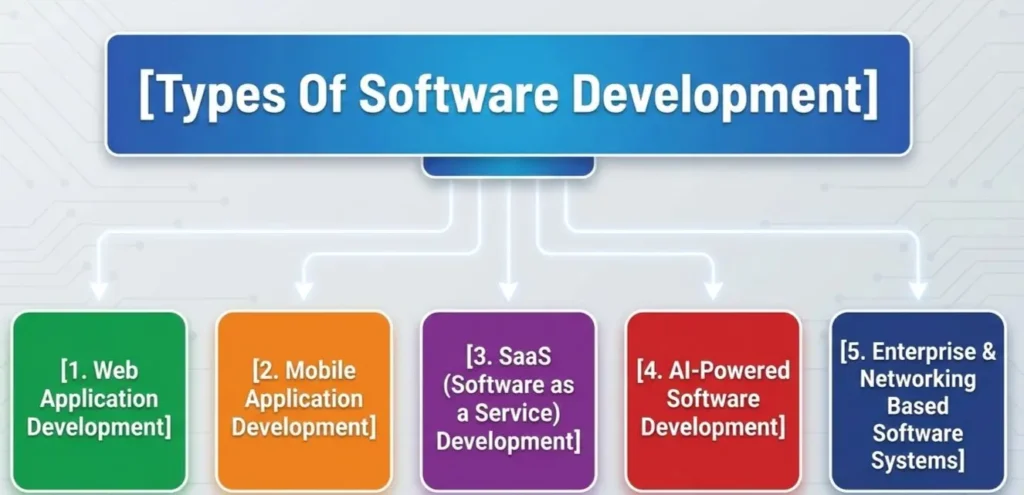
Let’s take a dive into the key types of software development every business leader should understand…
1. Web Application Development
Software website development focuses on building browser based applications that users can access online without installing software locally. These systems are highly flexible and are often the foundation of digital transformation projects.
For businesses, software web development powers:
- Customer portals
- Booking platforms
- Internal management dashboards
- CRM systems
- Inventory control systems
Modern software web development solutions often integrate with software networking infrastructure to allow multiple branches, remote teams, and stakeholders to access centralized systems securely.
Additionally, many web applications today are delivered using a software as a service model, meaning businesses subscribe to access cloud hosted platforms rather than installing them on physical servers.
When enhanced with software development AI, web platforms can include smart automation features like chatbots, predictive sales forecasting, or automated reporting.
For growing companies, software web development is often the starting point for scalable digital infrastructure.
2. Mobile Application Development
Mobile applications extend digital capabilities directly into customers’ and employees’ hands. While often connected to software web development backends, mobile apps provide a more personalized and accessible experience.
Businesses leverage mobile apps for:
- E-commerce transactions
- On-demand services
- Staff field operations
- Delivery tracking
- Customer engagement programs
These mobile systems rely heavily on software networking to synchronize real-time data between devices and central servers.
Many mobile solutions operate as software as a service, especially when subscription based access is required.
With software development AI, mobile applications can offer intelligent features such as recommendation engines, fraud detection, voice recognition, and behavior based notifications.
3. SaaS (Software as a Service) Development
Software as a service (SaaS) is one of the fastest growing models in global and Nigerian markets. Instead of purchasing software outright, businesses subscribe to cloud hosted solutions.
SaaS platforms are typically built through advanced software web development and supported by secure software networking infrastructure that ensures uptime, scalability, and remote accessibility.
Examples of SaaS platforms include:
- Accounting systems
- HR management tools
- Project management platforms
- CRM solutions
The advantage of software as a service lies in lower upfront cost, automatic updates, scalability, and accessibility from anywhere.
When all these are combined with software development AI, SaaS platforms can provide predictive analytics, workflow automation, and intelligent reporting, which can turn ordinary systems into smart business assistants.
4. AI-Powered Software Development
Software development AI refers to integrating artificial intelligence capabilities into business systems to automate decision making and improve efficiency.
AI-driven systems can:
- Analyze large datasets instantly
- Predict customer behavior
- Automate customer support
- Detect fraud
- Optimize supply chains
AI features are often embedded into software web development platforms or delivered through software as a service models.
Behind the scenes, strong software networking ensures that AI systems can process data across multiple branches, cloud environments, and databases in real time.
For executives, AI-powered software is not just a trend, it is a competitive advantage that reduces manual workload while increasing accuracy and speed.
5. Enterprise & Networking Based Software Systems
Large organizations often require complex enterprise systems that connect multiple departments and locations. This is where software networking becomes critical.
Enterprise platforms rely on robust software networking infrastructure to:
- Connect branches
- Synchronize databases
- Secure internal communications
- Enable remote access
These systems are typically built using structured software web development frameworks and may be deployed either on-premise or as software as a service.
When enhanced with software development AI, enterprise systems can automate procurement forecasting, compliance monitoring, operational risk assessment, and performance analytics.
For multi-location businesses, software networking ensures operational continuity and centralized visibility.
The Software Development Life Cycle (SDLC)
For business owners and executives, understanding the software development life cycle is critical to ensuring a successful digital project. The software development life cycle SDLC provides a structured framework that guides how software is planned, built, tested, deployed, and maintained.
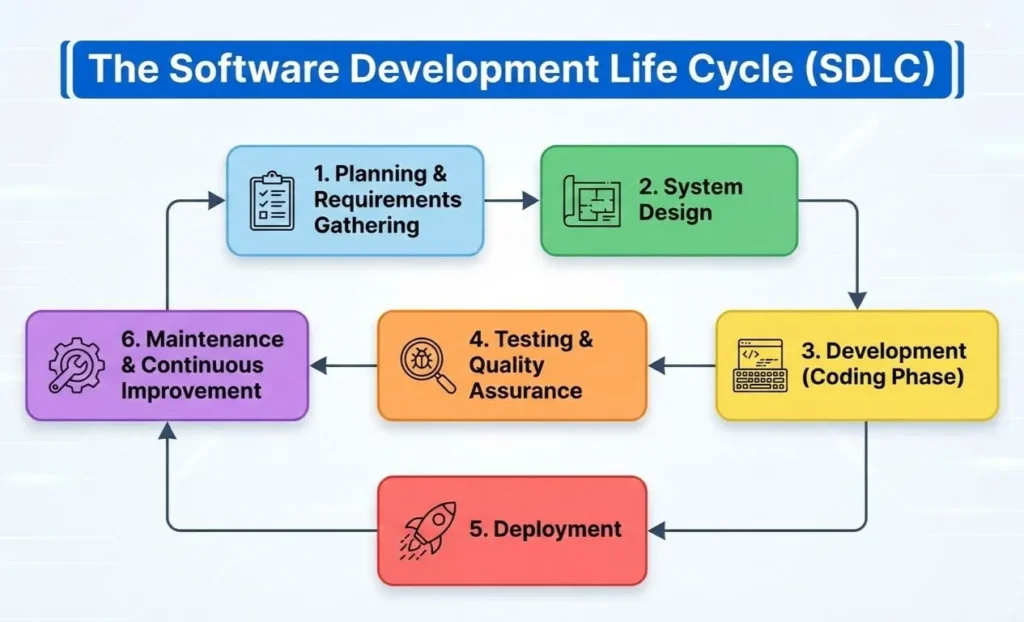
Rather than being a one time event, the software development cycle is a repeatable system that ensures quality, scalability, and long term business value. Each stage in the software development life cycle stages plays a strategic role in reducing risk, controlling costs, and aligning the final product with business objectives.
Below is a simplified breakdown of the key software development phases within the broader software development process.
1. Planning & Requirements Gathering
The first stage in the software development life cycle focuses on understanding the business problem. During this phase of the software development process, stakeholders define objectives, identify pain points, outline required features, and establish measurable KPIs.
This stage of the software development life cycle SDLC is critical because poor planning often leads to scope creep, budget overruns, and project delays. Clear documentation ensures the rest of the software development cycle stays aligned with business goals.
2. System Design
Once requirements are defined, the next of the software development life cycle stages is system design. Here, technical architects map out system structure, database architecture, integrations, and user experience flows.
This software development phase translates business needs into technical blueprints. A well-designed structure strengthens the entire software development process and prevents costly changes later in the software development cycle.
3. Development (Coding Phase)
During this core stage of the software development life cycle SDLC, developers write and build the actual system according to approved specifications.
This is where the conceptual work becomes functional software. However, within a structured software development process, coding is not done randomly, it follows the roadmap defined in earlier software development phases to ensure efficiency and maintainability.
4. Testing & Quality Assurance
Testing is one of the most important software development life cycle stages. Before launch, the system undergoes functional testing, performance testing, security validation, and usability checks.
This stage of the software development cycle ensures the software performs as expected under real world conditions. Skipping this step in the software development life cycle increases the risk of post-launch failures, security breaches, and reputational damage.
5. Deployment
Deployment marks the release of the solution into a live environment. In this stage of the software development life cycle SDLC, the application is configured on servers or cloud infrastructure and made accessible to users.
A controlled deployment strategy within the software development process minimizes downtime and ensures a smooth transition from development to real world use.
6. Maintenance & Continuous Improvement
The final stage in the software development life cycle stages is ongoing maintenance. Software is never truly “finished.” Businesses evolve, markets shift, and user expectations change.
This ongoing software development phase includes updates, feature enhancements, performance optimization, and security improvements. A mature software development cycle continuously adapts to business growth and technological advancements.
What Are Software Development Models?
While the software development life cycle (SDLC) defines the stages of building software, software development models determine how those stages are structured and executed. In simple terms, software development life cycle models provide the strategic framework for managing timelines, collaboration, testing, and delivery.
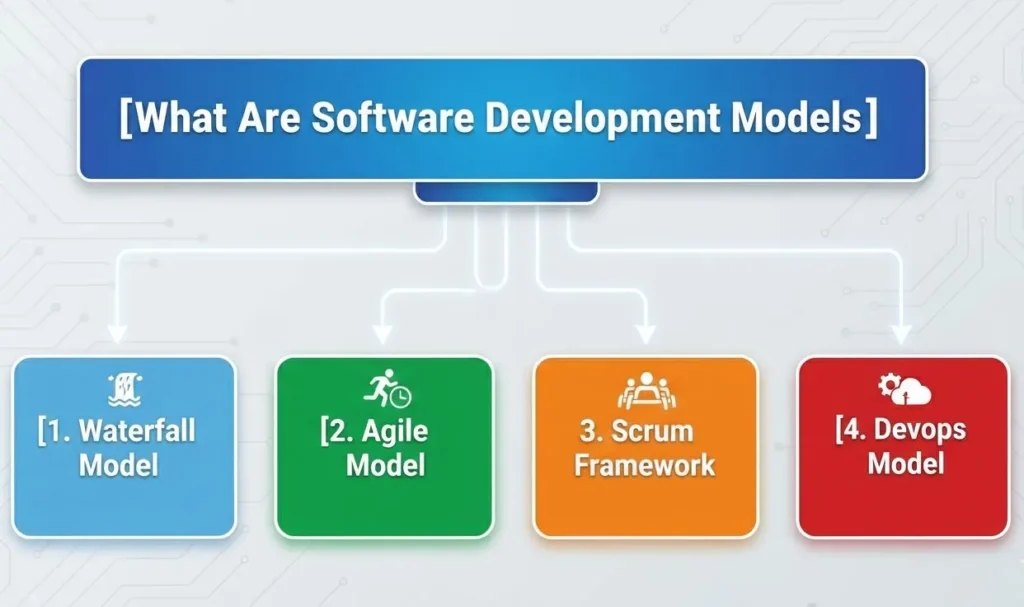
Different software development process models suit different business environments. Choosing the wrong model can increase costs, delay delivery, and create misalignment between stakeholders and developers. Below are the most common software development models business leaders should understand.
1. Waterfall Model
The Waterfall model is one of the oldest software development models. It follows a linear, step-by-step structure where each phase of the software development life cycle models must be completed before the next begins.
In this type of software development process models, requirements are defined upfront, and changes are difficult once development starts.
Waterfall model is best suited for projects with clearly defined requirements, Government or compliance heavy systems, businesses with fixed scope and predictable outcomes
While structured and easy to manage, the Waterfall model lacks flexibility if business needs evolve mid-project.
2. Agile Model
Agile is one of the most widely adopted modern software development models. Unlike linear software development life cycle models, Agile emphasizes iterative progress, collaboration, and continuous improvement.
In Agile based software development process models, software is built in short cycles (sprints), allowing businesses to test features early and make adjustments quickly. Agile reduces risk by allowing flexibility and constant stakeholder feedback throughout the development journey.
Agile based software development process models are best for:
- Startups and fast growing companies
- Projects where requirements may evolve
- Customer focused digital products
3. Scrum Framework
Scrum is a structured implementation of Agile within broader software development models. It divides work into short sprint cycles managed by defined roles such as Product Owner and Scrum Master.
Among software development life cycle models, Scrum is particularly effective when teams need rapid delivery and consistent feedback loops.
Scrum based software development process models improve accountability, transparency, and speed, which makes them ideal for businesses building scalable digital platforms.
4. DevOps Model
DevOps is one of the most advanced software development models, combining development and operations into a continuous integration and deployment cycle.
Unlike traditional software development life cycle models, DevOps promotes automation, monitoring, and rapid release cycles. DevOps enhances collaboration between development and IT operations teams, reducing downtime and improving scalability.
In modern software development process models, DevOps ensures faster deployment, improved reliability, and continuous performance optimization.
DevOps Model is best applicable for:
- SaaS companies
- Cloud-based systems
- Businesses requiring frequent updates
Choosing The Right Software Development Model For Businesses
From a business standpoint, selecting the right software development models is a strategic decision, not just a technical one.
Executives must evaluate; Project complexity, Budget flexibility, Timeline expectations, Regulatory requirements, Scalability goals, and Risk tolerance.
For example:
A large enterprise system with fixed regulatory compliance requirements may benefit from structured software development life cycle models like Waterfall.
A startup building a customer facing app may prefer Agile based software development process models for flexibility and faster iteration.
A SaaS platform expecting continuous updates may thrive under DevOps-driven software development models.
The key is alignment. The chosen software development process models must match your business growth strategy, not just technical preference.
On the other end understanding these software development life cycle models empowers stakeholders to:
- Set realistic expectations
- Improve collaboration
- Control risk exposure
- Ensure predictable ROI
Ultimately, the right development model directly impacts delivery speed, cost control, software quality, and long-term scalability.
Software Development Roadmap For Business Owners
For business owners and business managers, successful software development does not begin with coding, it begins with clarity. A well structured software development roadmap ensures that your investment aligns with business goals, budget expectations, operational realities, and long term scalability.
Every effective software development plan follows defined software development steps that reduce risk and improve delivery outcomes. In whatever case be it that you are launching new digital products or optimizing internal systems, strategic planning determines the success of your software development projects.
1. Identify The Business Problem
Every strong software development roadmap begins with identifying the core business challenges. Are you struggling with inventory tracking? Manual reporting? Customer retention? Operational inefficiencies?
Before launching any software development projects, certain things to keep in mind are; The problem, the impact on revenue, the operational bottleneck, the expected outcome.
Without clarity at this early stage, even the best software development plan may fail to deliver measurable value.
2. Define Scope And Objectives
The next of the critical software development steps is defining project scope. This stage determines what the software will and will not do. Clear scope control protects your software development projects from budget overruns and unnecessary complexity. A focused software development roadmap outlines:
- Core features (MVP)
- Future enhancements
- Timeline expectations
- Success metrics
3. Budget Planning
A practical software development plan must include financial forecasting. Budgeting involves more than development costs, it involves infrastructure, licensing, security, maintenance, training.
Well defined software development steps ensure that executives understand both upfront and long term investment requirements before committing to the full software development roadmap.
4. Development Team Selection
Choosing the right partner is one of the most strategic software development steps. Be it that you’re working with an in-house team or outsourcing, factors such as alignment in communication, expertise, and vision are critical decisions. A reliable partner strengthens the execution of your software development plan.
Successful software development projects depend on the following:
- Proven track record
- Industry experience
- Transparent communication
- Ongoing support capability
5. MVP Development (Minimum Viable Product)
Rather than building everything at once, smart software development roadmaps prioritize launching a Minimum Viable Product (MVP).
An MVP allows businesses to test core features, collect user feedback, validate assumptions, and reduce initial investment risk
This approach makes software development projects more adaptive and scalable while refining the overall software development plan.
6. Testing, Feedback, And Iteration
Testing is a non-negotiable part of any structured software development roadmap. Iterative improvements are critical software development steps that protect long-term system stability and business reputation.
Before full deployment, the system must be validated for the following:
- Functionality
- Security
- Performance
- User experience
7. Launch And Scalability
Deployment is not the end of software development, it is the beginning of optimization.
A forward-looking software development roadmap includes:
- Performance monitoring
- Data tracking
- Continuous updates
- Feature expansion
Successful software development projects evolve alongside business growth. Scaling strategically ensures that your original software development plan continues to deliver ROI over time.
How Much Does Software Development Cost In Nigeria?
One of the first questions business owners ask is: What is the real software development cost in Nigeria?
The honest answer is that software development pricing varies widely depending on complexity, scope, features, integrations, infrastructure, and long-term maintenance requirements. There is no one-size-fits-all number, because every business problem requires a tailored solution.
Below is a breakdown of the key factors that influence software development cost and what business owners and managers should consider before budgeting.
Key Factors That Affect Software Development Cost
1. Project Complexity
The complexity of your software development project significantly impacts pricing.
A simple internal dashboard will cost far less than a multi-branch enterprise system.
A basic web app is cheaper than a platform with AI integration, advanced analytics, or custom APIs.
The more technical layers, database architecture, security infrastructure, third-party integrations required for your software development, the higher the software development cost.
2. Feature Requirements
Every additional feature increases development time and resource allocation. When working with a software development company, clearly defining essential features versus optional features helps control cost without sacrificing performance.
For instance if your software requires the following;
- User authentication systems
- Payment gateway integration
- Real-time reporting dashboards
- Multi role access controls
- Mobile compatibility
3. System Integrations
If your software must connect with:
- Accounting platforms
- Inventory systems
- CRM tools
- Payment processors
- Government regulatory systems
The integration work will increase overall software development cost.
An experienced software development agency will evaluate integration requirements early to avoid unexpected budget overruns.
4. Timeline And Urgency
Faster delivery of software developments often requires more developers and longer work hours, which increases cost. If your business needs accelerated deployment, your chosen software development outsourcing company may allocate additional resources to meet deadlines, which will lead to affecting pricing.
5. Infrastructural Hosting
Software may be deployed On-premise, on cloud servers, as well as SaaS platforms.
Infrastructure decisions affect long-term operational costs beyond initial software development expenses. Cloud hosting, security monitoring, and server maintenance should be factored into your financial planning.
6. Maintenance
Software is not a one time expense. Updates, bug fixes, feature enhancements, and security patches require ongoing investment.
A reliable software development company typically offers support packages to ensure long term stability and performance.
In-House vs Outsourcing – Which Is More Cost-Effective?
When it comes to software development, businesses must decide whether to build internally or hire a software development outsourcing company.
1. In-House Development Requires:
- Higher long-term salary commitments
- Full internal control
- Suitable for tech focused enterprises
2. Outsourcing To A Software Development Agency Requires:
- Lower infrastructure and HR overhead
- Access to specialized expertise
- Faster project execution
- Flexible contract structures
For many Nigerian businesses, partnering with a reputable software development agency reduces risk while offering predictable cost structures.
Is Software Development Worth The Investment?
Instead of focusing solely on upfront software development cost, business owners and managers should evaluate:
- Operational cost reduction
- Revenue growth potential
- Productivity gains
- Error reduction
- Scalability benefits
Well executed software development projects often pay for themselves through automation, improved efficiency, and better decision making.
When strategically planned, the return on investment outweighs the initial cost.
How To Choose The Right Software Development Company
Selecting the right partner for your software development project is one of the most critical strategic decisions you will make as a business owner or executive. The wrong choice can lead to missed deadlines, budget overruns, technical debt, and underperforming systems. The right partner, however, becomes a long-term technology ally that drives innovation, efficiency, and sustainable growth.
With many software development companies in Nigeria, and particularly strong competition among software development companies in Lagos, business managers must go beyond surface level marketing and evaluate providers, using a structured checklist.
Below is a comprehensive executive level checklist to help you choose the right partner, and why Fortran House stands out among leading software companies in Nigeria.
1. Proven Experience In Business Focused Software Development
Not all software companies in Nigeria specialize in solving real business problems. Some focus only on basic website development or generic apps.
When evaluating software development companies in Nigeria, ask yourself these questions:
- Do they understand business operations, not just coding?
- Have they built enterprise grade systems?
- Do they align technology with measurable ROI?
Fortran House software development agency differentiates itself by building custom software tailored to real operational challenges across industries. Rather than delivering generic solutions, Fortran House approaches every software development project with a business first mindset, ensuring systems directly improve revenue, efficiency, and scalability.
Among software development companies in Lagos, Fortran House stands out for its strategic, consultative approach rather than transactional project execution.
2. Industry Specific Expertise
The best software development company near me should understand your industry’s workflows, compliance requirements, and operational bottlenecks.
Whether your business operates in:
- Hospitality
- Retail
- Logistics
- Healthcare
- Finance
- Manufacturing
A strong software development partner must demonstrate industry familiarity.
Fortran House has developed niche focused software platforms that reflect deep operational understanding, which makes it one of the most strategically positioned software companies in Lagos and across Nigeria.
This expertise ensures reduced learning curves and faster delivery timelines compared to inexperienced vendors.
3. Clear Development Process
Many software development companies in Nigeria lack structured communication and reporting systems. This often leads to uncertainty, delays, and frustration.
When choosing a partner, certain things to consider would be:
- Do they follow a documented development lifecycle?
- How do they provide progress updates?
- Is there a project manager assigned?
- Are timelines clearly defined?
Fortran House operates with structured development workflows, milestone based execution, and transparent communication, which gives stakeholders visibility at every stage of the software development process.
Compared to many software companies in Abuja and Lagos that operate informally, Fortran House delivers enterprise grade project governance.
4. Strong Technical Capability
Your chosen software development company near me must build scalable, secure, and future proof systems.
Before you engage any software development company or agency ask about:
- Technology stack
- Cloud infrastructure
- Security standards
- Database design
- Integration capabilities
Fortran House builds scalable digital infrastructures designed for long-term growth. Unlike smaller software companies in Nigeria that may build short-term solutions, Fortran House prioritizes:
- Clean architecture
- Security best practices
- Performance optimization
- Future scalability
This approach positions it among leading software development companies in Lagos serving ambitious growth focused businesses.
5. Client Testimonials And Proven Track Record
Before selecting a software development company near me, request for:
- Case studies
- Client testimonials
- Portfolio samples
- Performance results
Fortran House has built industry specific software platforms that demonstrate measurable impact. Its track record positions it among trusted software development companies in Nigeria serving businesses that require serious digital transformation.
Why Fortran House Is The Preferred Software Development Company
When comparing software development companies in Nigeria, businesses must evaluate long-term partnership value, not just price.
Fortran House delivers:
- Business driven software development
- Industry specific solutions
- Transparent project execution
- Scalable architecture
- Ongoing support
- Strategic consulting
For executives seeking reliable software companies in Lagos or trustworthy software companies in Nigeria, Fortran House represents a strong combination of innovation, reliability, and measurable business impact.
Choosing the right software development company near me should not be based on the lowest cost, it should be based on long-term value creation.
Conclusion
Every ambitious business reaches a point where spreadsheets, manual processes, and disconnected tools are no longer enough. At that stage, software development stops being an optional upgrade and becomes a strategic necessity.
The true value of software development lies not just in building applications, but in transforming business vision into scalable, efficient, and future ready digital systems. If your goal is to automate operations, improve customer experience, increase revenue streams, or gain real time insights, the right approach to software development turns ideas into measurable results.
Successful software development begins with clarity, clearly defined objectives, user needs, operational gaps, and long-term growth plans. It continues with strategic planning, strong architecture, secure infrastructure, and user focused design. Most importantly, it requires ongoing optimization to ensure your solution evolves as your business grows.
However, not all software development efforts produce these outcomes. The difference lies in strategic execution, experienced technical leadership, and a long-term mindset. Businesses that treat software development as a strategic investment, not just a technical project, consistently outperform those that approach it as a short-term expense.
As you consider your next move, remember, your vision deserves more than generic tools. It deserves tailored software development designed around your goals, market realities, and scalability needs.
The future of your business will be shaped by the decisions you make today. With the right software development strategy, you can turn complex challenges into streamlined systems, and bold ideas into powerful digital solutions.