
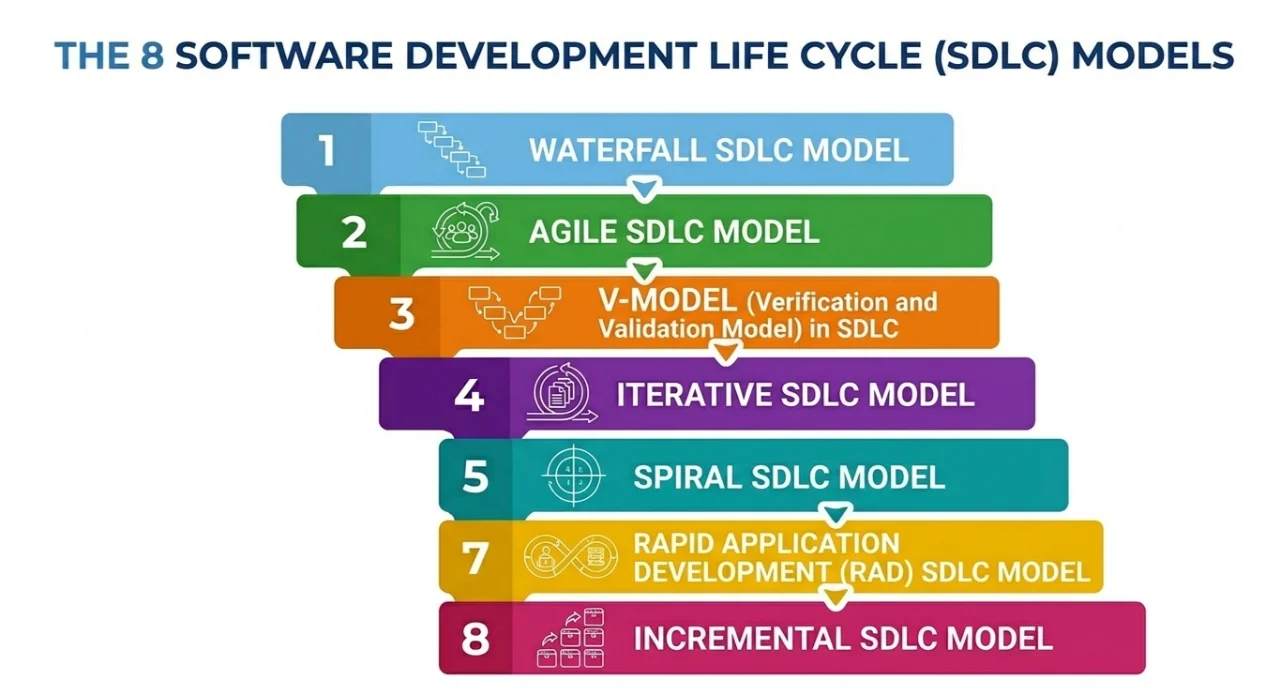
All 8 Software Development Life Cycle Models (SDLC) Explained
Many software projects out there either succeed or fail largely based on the process used to build them, which makes the Software Development Life Cycle (SDLC) essential for successful delivery. That’s why understanding what are the SDLC models is essential for businesses, developers.
The models of software development life cycle provide structured approaches that guides the planning, development, testing, and deployment from idea to launch, forming the foundation of modern software development.
With more than half a decade of knowledge we’ll explain software development life cycle SDLC models, to help you clearly understand what are the software development life cycle models and how they differ.
By exploring the most widely used software development life cycle model types, you’ll also understand the different types of software development suited for various business goals, and business needs in software development.
What Are Software Development Life Cycle Models?
Software Development Life Cycle models are structured frameworks that define how software is planned, built, tested, and maintained from start to finish, reflecting core software engineering principles. The models of software development life cycle organize development activities into clear phases, to guide dev teams manage complexity and reduce risks.
Indepth knowledge of software development life cycle SDLC models allows businesses and developers to choose the most effective workflow based on project goals.
Simply put, what are the software development life cycle models? They are proven methodologies that guide successful software delivery.
Overview Of The 8 SDLC Models (Quick Comparison)
Before choosing an approach, it’s important to understand how the models of software development life cycle differ in structure, flexibility, and risk management.
Comparison Table For All 8 SDLC Models
| SDLC Model | Unique Feature | Best Use Case |
| Waterfall SDLC Model | Linear and sequential development process where each phase is completed before the next begins. | Projects with clearly defined and stable requirements such as government, banking, or compliance based systems. |
| Agile SDLC Model | Iterative development with continuous feedback, collaboration, and incremental releases. | Startups, SaaS platforms, and products requiring frequent updates and evolving features. |
| V-Model (Verification & Validation) | Testing activities mapped directly to each development phase for strict quality control. | Critical mission or regulated systems that require high reliability and structured validation. |
| Iterative SDLC Model | Software is built through repeated cycles with continuous refinement. | Projects where requirements evolve gradually or user feedback shapes development direction. |
| Spiral SDLC Model | Risk driven development combining iteration with structured risk analysis. | Large, complex, or high risk enterprise software projects |
| DevOps SDLC Model | Continuous integration, delivery, and collaboration between development and operations teams. | Cloud applications, scalable platforms, and products requiring rapid deployment cycles. |
| Rapid Application Development (RAD) Model | Prototype based development focused on speed and user involvement. | UI-heavy applications, MVPs, and projects needing fast validation and quick market entry. |
| Incremental SDLC Model | Software delivered in functional increments, adding features progressively. | Long term products where features can be released step-by-step while maintaining usability. |
The 8 Software Development Life Cycle Models
1. Waterfall SDLC Model
The waterfall SDLC models follow a linear and sequential approach where each development phase must be completed before the next begins. The waterfall model meaning centers on structured progression through defined stages such as planning, design, development, and testing.
This waterfall model process emphasizes documentation, predictability, and clear milestones throughout the software development lifecycle.
Waterfall Model Stages
The waterfall SDLC models stages follow a structured sequence, often referred to as the waterfall model steps, where each phase is completed before moving forward. These waterfall model phases include:
- Requirements Analysis: All system requirements are gathered and documented to avoid changes later in development.
- System Design: Developers create technical architecture, database structure, and interface designs based on approved requirements.
- Development (Implementation): The software is coded according to predefined specifications and design plans.
- Testing: Quality assurance teams verify functionality, identify bugs, and ensure requirements are met.
- Deployment & Maintenance: The product is released to users, followed by ongoing updates, fixes, and performance monitoring.
3. V-Model (Verification and Validation Model) In SDLC
The v model methodology is a structured approach within the software development lifecycle that emphasizes early testing and quality assurance. To understand what is v model in SDLC, it helps to see it as an extension of sequential development where each development phase directly corresponds to a testing phase.
The v model software development methodology ensures that verification activities (design and development) are closely aligned with validation activities (testing and evaluation). This alignment makes the v model development process highly suitable for projects that require accuracy, compliance, and predictable outcomes, such as enterprise or regulated software systems.
By integrating testing from the beginning, the v model methodology promotes clear documentation and controlled project execution throughout the lifecycle.
Phases Of The V-Model
The v model development process follows a mirrored structure:
- Requirements Analysis → Acceptance Testing
- System Design → System Testing
- Architecture Design → Integration Testing
- Module Design → Unit Testing
- Coding Phase positioned at the center connecting both sides
This structure defines how the v model software development methodology systematically validates every development stage.
4. Iterative SDLC Model
The iterative SDLC model is a development approach where software is built and refined through repeated cycles rather than a single linear process. In the software development life cycle iterative model, development teams release an initial version early and continuously improve it based on testing results and stakeholder feedback.
Unlike fixed development structures, iterative methodologies focus on gradual enhancement, which allows requirements to evolve as the project progresses.
This makes the iterative SDLC model effective for projects where user needs may change or become clearer during development, ensuring steady product improvement while maintaining alignment with business goals.
Iteration Workflow
The software development life cycle iterative model typically follows these steps:
- Planning: Define goals and scope for the iteration.
- Design: Create solutions for selected features.
- Development: Build functional components.
- Testing: Validate performance and identify improvements.
- Evaluation: Gather feedback to guide the next iteration cycle.
5. Spiral SDLC Model
The spiral SDLC model combines iterative development with structured risk management, helping organizations avoid many of the reasons software projects fail.
To understand what is spiral model in SDLC, it can be viewed as a cycle driven approach where planning, development, and evaluation repeat in controlled loops. The software development life cycle spiral model emphasizes continuous refinement while assessing potential risks before moving forward.
Each loop in the spiral model process represents progress toward a more complete system, this model ensures technical and business risks are addressed early. This structured yet flexible nature defines how the spiral SDLC model supports controlled innovation and software delivery.
Spiral Model Stages
The spiral model stages typically include:
- Planning
- Risk Analysis
- Engineering (Design & Development)
- Evaluation and Feedback
Risk Evaluation In Development
Risk assessment is central to the spiral model process, this specifically help teams identify technical challenges, cost concerns, and requirement uncertainties before advancing to the next development cycle.
6. DevOps SDLC Model
The devops sdlc model represents a modern evolution of software delivery where development and operations teams work together, often leveraging AI-driven software development practices. Within the devops software development lifecycle, automation, collaboration, and continuous monitoring drive faster and more reliable releases.
The devops model focuses on shortening development cycles while maintaining stability through continuous testing and deployment practices.
DevOps Lifecycle Flow
The devops lifecycle follows a continuous loop designed to support rapid delivery and operational efficiency:
- Planning: Project teams define features, priorities, and technical requirements in connection with business objectives within the devops software development lifecycle.
- Development: Developers write and update code collaboratively using shared repositories that support the devops model approach.
- Continuous Integration: Code changes are automatically merged and tested to detect issues early in the devops sdlc model workflow.
- Testing: Automated testing validates functionality, performance, and security before deployment stages.
- Deployment: Applications are released through automated pipelines, enabling frequent and reliable delivery.
- Operations: Infrastructure monitoring ensures application stability and system performance across environments.
- Continuous Feedback: Insights from users and system monitoring feed back into planning, sustaining the iterative nature of the devops lifecycle.
7. Rapid Application Development (RAD) SDLC Model
The rapid application development approach focuses on fast delivery through user collaboration and iterative prototyping rather than lengthy planning cycles.
The rapid application development framework enables development teams to quickly build functional components, gather feedback, and refine features continuously. Within the rapid application development process, flexibility and speed are prioritized, which makes it ideal for projects requiring quick validation and evolving requirements.
RAD Development Stages
The rapid application development model phases typically include:
- Requirements Planning
- User Design
- Rapid Construction
- Deployment
Prototype Based Development
A core principle of the rapid application development approach is the prototype driven collaboration. Project teams build working prototypes early in the rapid application development process, this allows stakeholders to test functionality, suggest refinements, and shape the final product through continuous interaction within the rapid application development framework.
8. Incremental SDLC Model
The software development life cycle incremental model delivers software in smaller functional releases rather than a single final product launch. In the incremental process model, development is divided into multiple builds, with each increment adding new capabilities to the system.
This structured incremental process allows teams to validate features progressively while maintaining steady project momentum.
By focusing on staged delivery, the software development life cycle incremental model helps organizations align development progress with evolving business needs and user feedback.
Feature Based Development Approach
The incremental process model follows a feature-driven strategy where requirements are prioritized and implemented step by step. Each incremental process cycle includes planning, development, testing, and integration of a specific feature set.
This approach enables teams using the software development life cycle incremental model to release usable software early enouigh.
How To Choose The Right SDLC Model For Your Business
Selecting among software development life cycle model types depends on business goals, project complexity, and expectations. Organizations evaluate different models of software development life cycle using practical decision factors such as:
- Project Requirements Stability: Fixed requirements often align with structured software development life cycle model types, while evolving needs favor adaptive models.
- Team Collaboration Style: Businesses assess how internal teams and external agencies can operate efficiently within different models of software development life cycle.
- Time To Market Goals: Faster delivery timelines influence the choice of flexible software development life cycle model types.
- Risk And Compliance Needs: Regulated industries prioritize controlled different models of software development life cycle with strong validation processes.
- Client Involvement Level: High stakeholder feedback cycles guide companies toward iterative software development life cycle model types.
Understanding SDLC Models Before Starting A Software Project
Understanding software development life cycle models is essential before launching any software initiative. Knowing what are the SDLC models helps businesses, founders, and development teams align project goals with the right execution strategy.
By evaluating software development life cycle models early, organizations can improve planning, collaboration, and delivery outcomes. A clear understanding of what are the SDLC models ultimately supports smarter decision making and more predictable software project success.
Author