
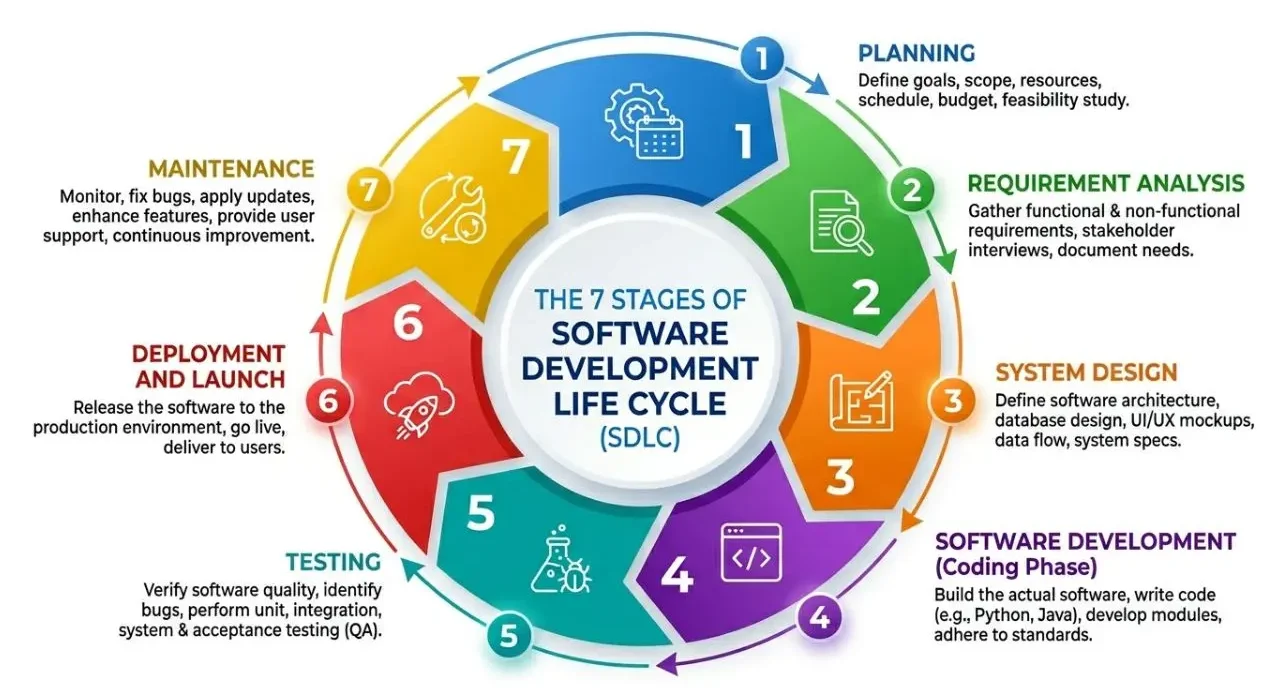
A Breakdown Of What Software Development Life Cycle (SDLC) Is
The software development life cycle is the structured framework that guides how software products are planned, built, tested, and maintained from idea to deployment. Understanding the software development life cycle helps founders, businesses, and developers clearly see how successful system solutions are created using proven software engineering principles.
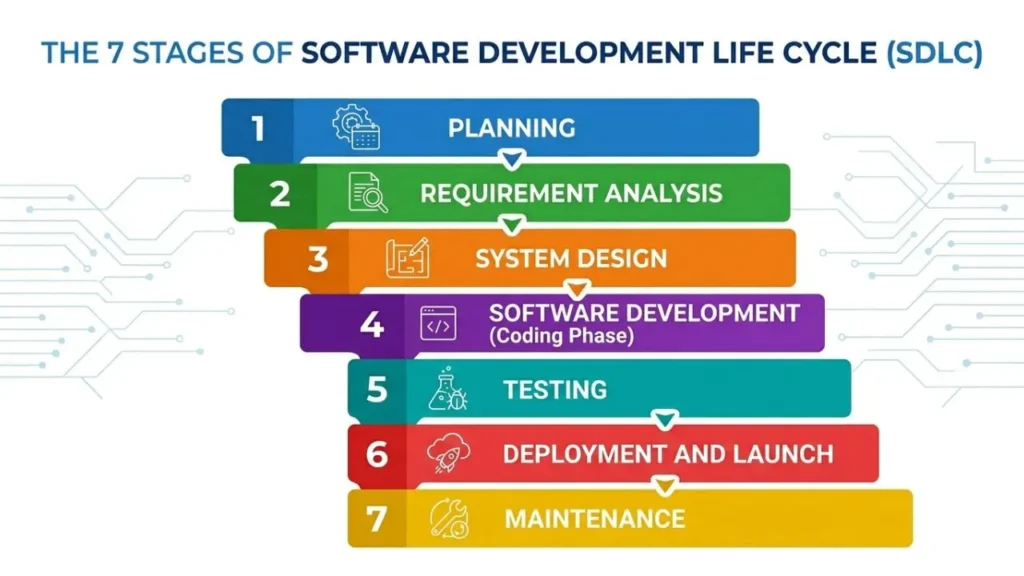
Rather than random coding, the software development life cycle ensures every phase follows a defined process that reduces risk, improves quality, and aligns technology with business goals. Let’s walk you through a complete breakdown of the software development life cycle and how it works.
What Is Software Development Life Cycle (SDLC)?
Software development life cycle meaning refers to a structured process used by development teams to plan, design, build, test, deploy, and maintain software efficiently. When asking what do you mean by software development life cycle, it simply describes the standard framework that ensures software projects follow clear stages instead of unorganized development.
Commonly known as SDLC, this approach helps businesses manage timelines, control costs, improve collaboration, and deliver reliable digital products through a repeatable and measurable development process, as explained in this software development guide for business owners.
Why Software Development Life Cycle Matters For Businesses & Startups
1. Predictable Timelines
The software development life cycle process provides structured phases that allow business teams to define milestones, deliverables, and deadlines from the beginning. Through SDLC, businesses gain visibility into development progress, making it easier to forecast releases, and understand the value of software development for business growth.
2. Budget Control
A clearly defined software development life cycle process enables accurate cost estimation before development begins. Using SDLC, start up teams allocate resources efficiently, to prevent scope creep, and minimize unexpected expenses. Each stage includes evaluation checkpoints that ensure spending aligns with project goals.
3. Risk Reduction
The software development life cycle process reduces uncertainty by identifying technical and operational risks early, helping organizations avoid common reasons software projects fail. Through structured validation in SDLC, work teams detect issues during planning and testing instead of after launch.
4. Quality Assurance
Quality is embedded into every phase of the software development life cycle process rather than treated as a final step. SDLC integrates continuous testing, reviews, and performance validation to ensure software reliability.
5. Investor Confidence
Following a defined software development life cycle process demonstrates professionalism and execution readiness to investors. SDLC provides measurable progress, documented milestones, and transparent workflows that validate project viability.
The 7 Stages Of Software Development Life Cycle Explained
The 7 stages of the software development life cycle provide a structured path that guides software projects from planning to maintenance. These system development life cycle stages help development teams manage complexity through clearly defined activities and deliverables.
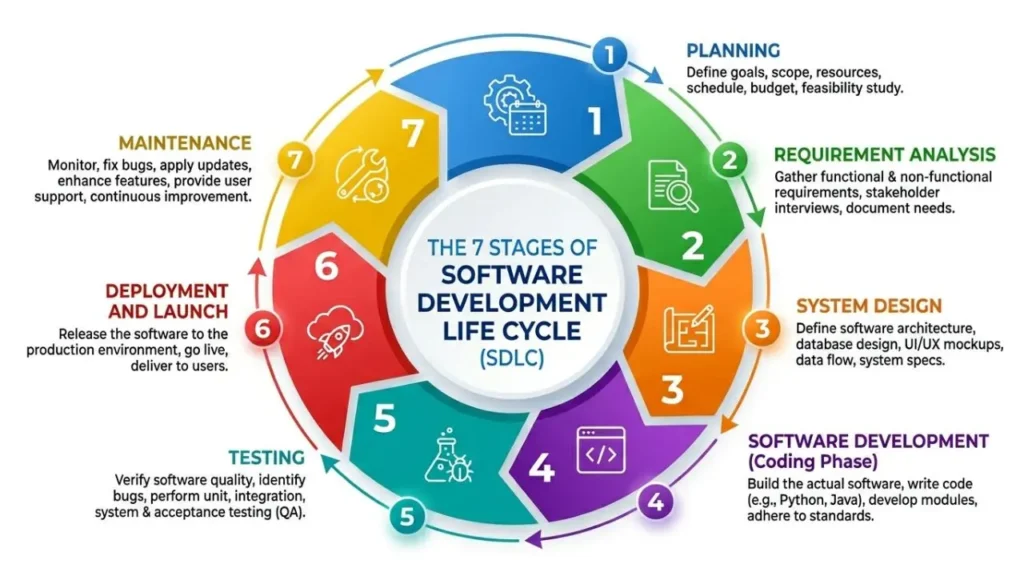
A typical system development life cycle diagram visually represents how each stage connects, ensuring smooth workflow, better collaboration, and consistent progress throughout the entire development process.
Stage 1 – Planning
Planning is the foundation of the stages of software development life cycle, where project goals, requirements, and feasibility, and decisions about custom software vs off-the-shelf solutions are clearly defined. During this phase, development teams analyze business needs, estimate costs, identify risks, and outline project scope.
As one of the most critical system development life cycle stages, planning ensures the software development life cycle process begins with clear direction, to help stakeholders align expectations while creating a structured roadmap for successful software development execution.
Stage 2 – Requirement Analysis
Requirement analysis is a crucial phase within the stages of software development life cycle, where detailed functional and technical needs are gathered from stakeholders. During this phase, development teams document user expectations, system specifications, and project constraints.
As one of the essential system development life cycle stages, it ensures clarity before design begins. A well defined requirement phase strengthens the software development life cycle process.
Stage 3 – System Design
System design transforms requirements into technical blueprints within the stages of software development life cycle. During this phase, developmet teams define system architecture, database structure, user experience flows, and technology stack decisions.
As one of the core system development life cycle stages, design ensures scalability and usability before coding begins. A well planned design phase (UI/UX) strengthens the software development life cycle process, as it enables developers to build efficient, secure, and user focused software solutions.
Stage 4 – Software Development (Coding Phase)
The coding phase is where ideas become fully functional products within the stages of software development life cycle. Developers translate system designs into working software by writing, integrating, and optimizing code based on defined specifications.
This is the most execution focused system development life cycle stages, this phase emphasizes collaboration, version control, and iterative progress. A structured software development life cycle process ensures consistent development standards and implementation that aligns with project goals.
Stage 5 – Testing
Testing and quality assurance validate software performance and functionality before release. Within the system development life cycle stages, this phase ensures bugs, vulnerabilities, and performance issues are identified early. A strong focus on software development life cycle security helps protect applications from risks and cyber threats.
By following a secured software development life cycle, development teams implement continuous testing, security checks, and validation processes that guarantee stable, secure, and high quality software delivery.
Stage 6 – Deployment And Launch
Deployment marks the transition from development to real world usage within the software development life cycle SDLC. During this phase, the application is released to production environments, configured for users, and monitored for performance.
As one of the final system development life cycle stages, deployment ensures smooth rollout with minimal disruption. A structured SDLC approach supports controlled releases, proper documentation, and readiness for user adoption.
Stage 7 – Maintenance & Continuous Improvement
Maintenance ensures software remains functional, secure, and relevant after launch within the software development life cycle SDLC. This phase involves performance monitoring, bug fixes, feature updates, and system optimization based on user feedback.
As one of the ongoing system development life cycle stages, maintenance extends product lifespan and improves user satisfaction. A well managed SDLC supports continuous improvement, which basically allows businesses to adapt software to evolving technologies, market needs, and business demands.
Different Types Of Software Development Life Cycle Models
There are several software development life cycle types, and each of them are designed to suit different project needs and business goals within SDLC practices.
- Waterfall Model
- Agile Model
- Iterative Model
- Spiral Model
- DevOps Lifecycle
The waterfall model software development follows a linear approach where each phase is completed before the next begins. In contrast, the agile model software development life cycle promotes flexibility through iterative releases and continuous feedback.
The iterative model in software development improves products through repeated refinement, while the spiral model for software development combines risk analysis with progressive development cycles.
Development teams also adopt the devops software development lifecycle, integrating development and operations to enable faster delivery, automation, and continuous improvement across the entire SDLC framework.
Common SDLC Mistakes Businesses Should Avoid
Many projects fail due to poor execution of the software development life cycle process rather than technical limitations. Avoiding common mistakes helps organizations maximize the value of the system development life cycle and maintain efficiency throughout SDLC implementation.
- Unclear Requirements: Weak planning disrupts the software development life cycle process and leads to costly revisions.
- Skipping Documentation: Poor recordS usually create confusion across the system development life cycle stages.
- Ignoring Testing Phases: Rushing delivery most times weakens quality and reduces SDLC effectiveness.
- Lack Of Stakeholder Involvement: Misalignment slows decisions within the software development life cycle process.
- Poor Risk Management: Failure to anticipate issues weakens project stability across the system development life cycle, increasing long term development risks.
How Fortran House Applies The Software Development Life Cycle
At Fortran House, the system development life cycle is applied through a structured, client focused approach that ensures transparency, efficiency, and measurable outcomes. As a leading software development company in Nigeria, Fortran House follows proven SDLC practices covering planning, design, development, testing, deployment, and continuous improvement.
Each project is well articulated with business objectives, which allows startups and enterprises to track progress through clear milestones. By combining industry standards with practical execution, Fortran House delivers reliable software solutions through a disciplined SDLC framework.
Author