

How Inventory Management Software Increases Profit For Business
Many businesses unknowingly lose money every day, not because of low sales, but because of poor stock management. Without Inventory Management Software, issues such as overstocked warehouses and expired products to stockouts and inaccurate inventory counts, inefficient stock management quietly drains revenue, increases operational costs, and reduces profit margins for many businesses.

For lot’s of businesses out there, relying on spreadsheets or manual tracking sy stems might no longer be sustainable. Without reliable inventory management solutions, business owners and managers are struggling with limited visibility, delayed reporting, and costly decision making errors. Poor stock management doesn’t just affect operations, it directly impacts cash flow, customer satisfaction, and long term profitability.
This is where modern inventory management solutions become essential. By transforming traditional stock management into an automated, and data driven process, businesses can eliminate waste, prevent losses, and unlock new profit opportunities. When properly designed and implemented, inventory management solutions turn stock management from a financial liability into a strategic profit engine.
What Is Inventory Management Software And Why Does It Matters
Inventory Management Software is a centralized digital system that helps businesses track, control, and optimize their inventory in real time. Unlike manual tools or basic applications, modern systems built through professional inventory management software development are tailored to match a company’s operational workflow, supply chain structure, and reporting needs. This ensures accurate stock tracking, automated updates, and seamless integration with accounting, POS, ERP, and e-commerce platforms.
At the core of these systems is a powerful inventory management software dashboard that provides visibility into stock levels, product movement, reorder points, and performance metrics. A well designed inventory management software dashboard empowers business owners, managers, and stakeholders to make fast, data driven decisions which reduces losses and improves profitability. Through strategic inventory management software development, companies will gain a scalable solution that turns inventory control into a competitive advantage.
The Real Causes Of Inventory Losses In Businesses
Inventory losses rarely happen overnight. They build up gradually through weak processes, poor visibility, and outdated stock management practices. For many organizations, especially growing enterprises that have not yet adopted inventory management software small business solutions, these hidden inefficiencies slowly erode profit margins.
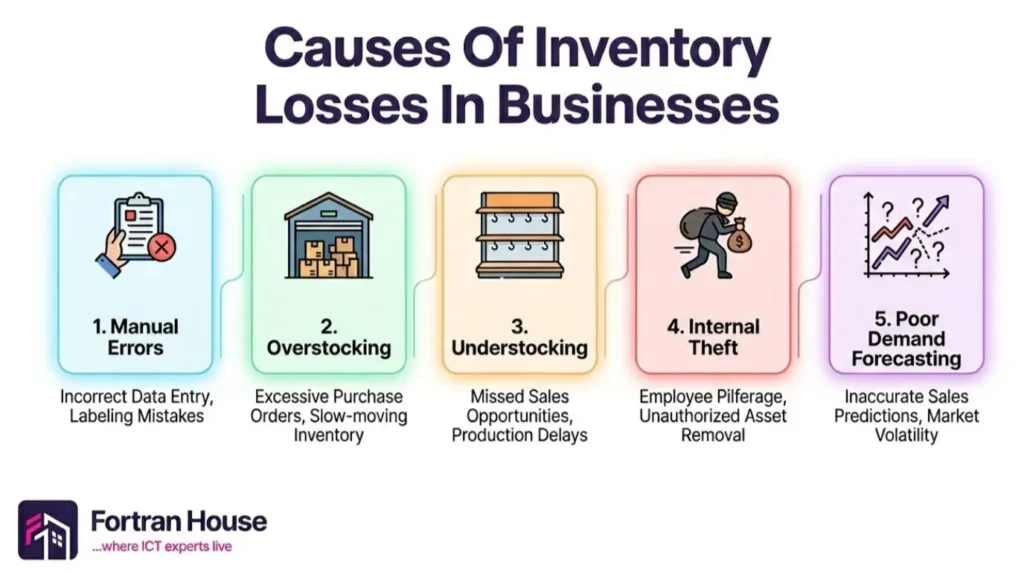
Below are the five major causes of inventory losses that businesses must address to protect revenue and increase profitability.
1. Manual Errors:
Manual stock management systems, spreadsheets, and paper based logs are highly prone to human error. Duplicate entries, incorrect stock counts, misplaced decimal points, and delayed updates can distort inventory data significantly. When inventory records are inaccurate, purchasing decisions, sales forecasting, and replenishment planning all suffer.
For small and mid-sized companies, relying on outdated methods instead of implementing inventory management software small business solutions creates blind spots in operations. Even minor counting errors, when repeated consistently, can lead to thousands of dollars in losses annually. Without automation and accurate tracking, manual stock management becomes a liability rather than a control system.
2. Overstocking:
Overstocking is one of the most common consequences of poor stock management. When businesses lack accurate demand insights, they often purchase excess inventory to “stay safe.” While this may seem like a protective strategy, it ties up working capital, increases storage costs, and leads to slow moving or obsolete stock.
Dead stock not only occupies warehouse space but also locks cash flow that could be reinvested into growth opportunities. Businesses that fail to adopt inventory management software small business systems, often struggle to identify slow moving products early enough. Effective stock management requires clear insights that prevent over purchasing and optimize reorder levels.
3. Understocking:
While overstocking ties up capital, understocking leads directly to lost revenue. Poor stock management can result in unexpected stockouts, forcing businesses to turn customers away or delay orders. In today’s competitive market, customers rarely wait, they move to competitors.
Small businesses without inventory management software small business tools often lack that visibility into stock levels across locations. This disconnect causes reactive purchasing instead of proactive planning. Consistent stockouts damage brand reputation, reduce repeat purchases, and ultimately shrink profit margins.
4. Internal Theft:
Inventory shrinkage due to internal theft, misplaced items, or unrecorded usage is another major source of loss. Weak stock management controls create opportunities for discrepancies to go unnoticed. Without clear accountability, access control, and audit trails, businesses struggle to trace inventory movement accurately.
Inventory management software small business solutions provide structured oversight that manual systems cannot. By assigning role based access and tracking every transaction, businesses strengthen stock management transparency and reduce shrinkage risks. Without such controls, inventory losses can quietly compound over time.
5. Poor Demand Forecasting:
Accurate forecasting is the foundation of effective stock management. When businesses rely on guesswork instead of data, they misjudge seasonal trends, customer preferences, and purchasing cycles. This results in either excess stock or insufficient supply, both of which negatively impact profitability.
Inventory management software small business platforms provide historical sales data, trend analysis, and performance insights that improve forecasting accuracy. Without these insights, businesses operate reactively, constantly adjusting to problems instead of preventing them. Strong stock management supported by intelligent systems allows companies to anticipate demand, optimize purchasing decisions, and protect profit margins.
How Does Inventory Management Software Reduce Business Losses
Reducing losses requires more than basic tracking, it demands intelligent systems built with precision. Modern Inventory Management Software delivers measurable results when backed by strategic inventory management software development and supported by a powerful inventory management software dashboard. Below are five critical ways it minimizes losses while transforming everyday stock management into a structured, profit protecting process.
1. Accurate Inventory Tracking
One of the most important inventory management software benefits is real-time tracking. Instead of relying on delayed updates or manual reconciliation, businesses will gain instant visibility into stock levels, product movement, and inventory location.
Through professional inventory management software development, systems are designed to automatically update inventory records whenever a sale, return, or transfer occurs. This eliminates discrepancies and reduces costly errors caused by outdated data. With a centralized inventory management software dashboard, managers can monitor stock levels across multiple branches, warehouses, or sales channels without guesswork.
Accurate, stock management prevents inventory mismatches, reduces administrative workload, which significantly lowers the risk of financial loss.
2. Automated Reorder Points:
Manual restocking often leads to either over-purchasing or understocking. One of the most valuable inventory management software benefits is automated reorder point configuration. The system monitors inventory thresholds and triggers alerts when stock reaches predefined levels.
A well built inventory management software dashboard displays low stock alerts, supplier timelines, and purchase history, which enables proactive decision making. With proper inventory management software development, reorder rules can be customized based on seasonal demand, sales velocity, and supplier lead times.
This automation strengthens stock management by preventing stockouts that cause lost sales and overstocking that ties up capital which leads to business losses.
3. Expiry And Batch Tracking:
For industries dealing with perishable or regulated goods, expiry tracking is very essential. Inventory management software benefits extend beyond quantity tracking to include batch numbers, manufacturing dates, and expiry alerts.
A well structured inventory management software dashboard highlights products nearing expiration, helping teams take action before losses occur. Through tailored inventory management software development, many businesses can configure automated notifications, FIFO (First-In, First-Out) controls, and compliance tracking mechanisms.
4. Centralized Multi-Location Control:
Businesses operating across multiple warehouses or retail outlets often struggle with fragmented stock management. Without a centralized system, inventory data becomes inconsistent and difficult to reconcile.
One of the major inventory management software benefits is unified visibility across all locations through a single inventory management software dashboard. Executives can view total stock value, branch performance, and product movement.
With strategic inventory management software development, multi-location tracking is better integrated into one ecosystem. This prevents duplicate purchases, reduces inter branch stock imbalance, and ensures better allocation of resources. Centralized stock management strengthens operational control and eliminates hidden losses caused by poor coordination.
5. Role-Based Access And Audit Trails
Internal shrinkage and unauthorized adjustments are common causes of inventory loss. Advanced inventory management software benefits include role based access controls and comprehensive audit logs.
A detailed inventory management software dashboard records every transaction, who updated inventory, when it was changed, and what adjustments were made. This transparency increases accountability across departments.
Through secure inventory management software development, businesses can define user permissions based on roles, ensuring that sensitive stock management actions are restricted to authorized personnel only. Audit trails create traceability, reduce internal fraud risks, and strengthen operational discipline, ultimately protecting revenue.
How Inventory Management Software Increases Profit Margins For Businesses
Increasing profit margins is not just about driving more sales, it is about controlling costs, optimizing resources, and making smarter decisions. One of the most measurable inventory management software benefits is improved cash flow. When stock management is automated and precise, businesses avoid overpurchasing and reduce capital tied up in excess inventory. Through strategic inventory management software development, companies can implement systems that align purchasing cycles with real demand, ensuring money is invested in high performing products instead of sitting idle in warehouses.
Another powerful driver of profitability is data backed forecasting. A well designed inventory management software dashboard provides clear insights into product performance, seasonal trends, and customer buying patterns. These insights enable leadership teams to anticipate demand rather than react to it. With accurate forecasting built into the inventory management software development process, businesses can strengthen stock management planning, reduce emergency procurement costs, and negotiate better supplier terms, directly improving gross margins.
Operational efficiency also plays a major role in profit growth. Effective stock management supported by an intelligent inventory management software dashboard streamlines order fulfillment, reduces processing errors, and shortens delivery timelines. These efficiency gains are key inventory management software benefits that lead to higher customer satisfaction and increased repeat purchases. When systems are custom built through professional inventory management software development, they integrate perfectly with accounting, POS, ERP, and e-commerce platforms, thereby eliminating redundancies and lowering operational expenses.
How Fortran House Builds Inventory Management Software That Reduces Losses For Businesses
1. Business Process Analysis:
As a results driven inventory management software development company, Fortran House begins every project with deep business process analysis. Before writing a single line of code, the team evaluates existing workflows, identifies stock leak points, and uncovers operational inefficiencies. This strategic discovery phase ensures that the inventory management software development process is aligned with real business challenges, forming the foundation for highly effective custom inventory management software that directly reduces losses.
2. Custom System Architecture
Fortran House designs scalable system architectures that is tailored to each client’s operations. Through expert inventory management software development, the company builds secure, cloud enabled infrastructures that support multilocation tracking, automated workflows, and data processing. Unlike generic tools, Fortran House custom inventory management software is structured to match your unique stock movement patterns and reporting requirements of each business.
3. Smart Dashboard & Reporting
A powerful analytics interface is central to every solution built by Fortran House inventory management software development company. Fortran House develops intuitive dashboards that provides clear insights into stock levels, sales trends, reorder points, and performance metrics, a clear example is the Venus Hotel Software. This custom inventory management software dashboard empowers executives and managers to make fast, data oriented decisions which prevent overstocking, eliminate stockouts, and minimize revenue leakage.
4. Integration With Existing Business Systems
Effective inventory management software development goes beyond standalone functionality. Fortran House ensures seamless integration between its custom inventory management software and existing systems such as accounting platforms, ERP solutions, POS systems, and e-commerce stores. As a forward-thinking inventory management software development company, the goal is to create a unified digital ecosystem that eliminates data silos and reduces operational friction.
5. Ongoing Optimization & Support
Inventory challenges evolve as businesses grow, which is why Fortran House provides continuous improvement beyond initial deployment. As a trusted inventory management software development company, Fortran House monitors performance, refine features, and scale capabilities as needed. Through ongoing inventory management software development enhancements, Fortran House custom inventory management software remains optimized to reduce losses and sustain long term profitability.
Conclusion
Inventory losses are not inevitable, they are preventable with the right strategy and technology. By investing in professional inventory management software development, your business can eliminate costly stock errors, improve operational visibility, and increase sustainable profit growth. Partnering with an experienced inventory management software development company ensures your system is built around your unique processes, giving you a scalable solution that transforms inventory from a recurring expense into a powerful profit-driving asset.