

How We Built a Powerful Hotel Management Software for Nigerian Hotels
Running a hotel in Nigeria is fundamentally different from running one in Europe or North America, which is why many hotels now compare different hotel management software for hotels in Nigeria before choosing a solution. That disconnect is where the problems begin.
Nigerian hotels deal with a unique mix of realities: walk-in guests still dominate, phone and WhatsApp bookings are common, and payments come in through transfers, POS, cash, and online gateways, and infrastructure is not always predictable. Staff structures are lean, roles often overlap, and owners frequently manage remotely.
When foreign software ignores these realities, hotels compensate manually, which is one reason businesses increasingly compare custom software vs off-the-shelf solutions. Staff revert to notebooks, spreadsheets, or memory. Over time, this creates revenue leakage, reporting gaps, and operational stress that only gets worse as the hotel grows.
This is the environment we design for, not an idealised version of hospitality operations, but the one Nigerian hotels actually operate in.
Why We Start With Understanding, Not Code
Most software projects fail because they begin with features instead of understanding, similar to the reasons discussed in why most software projects fail in Nigeria.
We take the opposite approach. At Fortran House, we designed our hotel management system by first undertaking a deep operational analysis.
We observe how bookings arrive, how rooms are assigned, how payments are recorded, how housekeeping is coordinated, and how decisions are made when things go wrong.
We identify where money is lost, where time is wasted, and where staff rely on informal
workarounds to keep things moving.
We identify where money is lost, where time is wasted, and where staff rely on informal
workarounds to keep things moving.
These workarounds are signals. They show us what the software must support.
Only after this clarity do we design software that supports effective software development for business operations. That discipline is why adoption is high, and
resistance is low.
Designing Software Around Local Workflows
In many Nigerian hotels, rigid software workflows slow staff down. Front desk officers need speed, not menus. Housekeeping needs clarity, not complexity. Managers need visibility, not noise.
We design workflows that mirror existing habits, then remove friction quietly. Walk-in
bookings are fast to record. Phone reservations are easy to track. Room status updates are simple and immediate.
The system fits into daily operations naturally. Staff do not feel like they are “using
software”. They feel like work is simply easier.
Payments Built for How Money Actually Moves
Payment handling is one of the biggest weaknesses of generic hotel software in Nigeria.
Many systems assume card-only or online-first transactions, which do not reflect reality.
We built payment workflows that support bank transfers, POS payments, cash tracking, and local payment gateways, similar to best practices for integrating local payment systems in Nigeria. Partial payments, delayed confirmations, and mixed payment methods are handled without breaking records.
This reduces disputes, improves accountability, and gives owners confidence that the reported numbers reflect reality.

Room, Front Desk, and Housekeeping Coordination
As hotels grow, verbal coordination between the front desk and housekeeping breaks down.
Rooms stay idle longer than necessary. Guests wait unnecessarily. Staff become frustrated.
Our systems connect check-outs directly to housekeeping tasks. Room cleaning status updates instantly. Front desk staff can see availability in real time without calling or guessing.
The result is faster room turnover, fewer conflicts, and smoother peak-hour operations
without increasing staff workload.
Reporting That Answers Real Questions
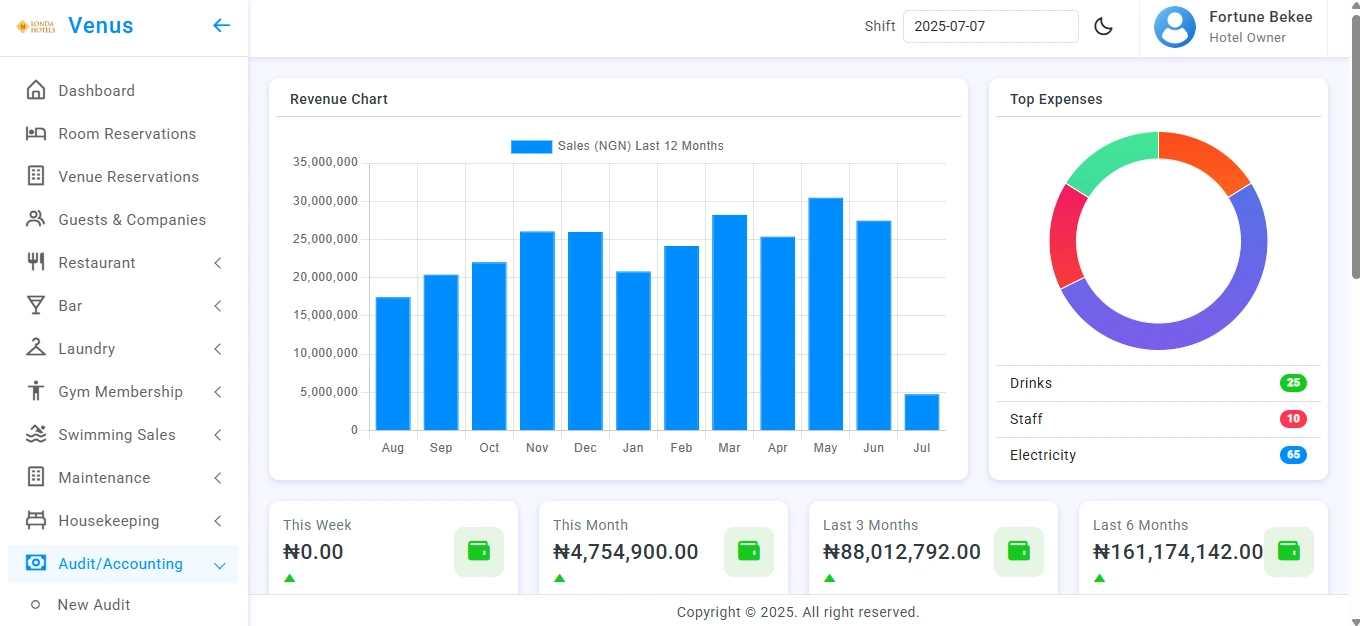
Most hotel dashboards look impressive but offer little clarity. Nigerian hotel owners do not need charts for decoration. They need answers.
We design reports around practical questions: which rooms generate the most revenue, which days underperform, where occupancy leaks occur, and how each staff shift performs during peak periods.
Reports are simple, actionable, and accessible remotely, reflecting the flexibility businesses expect from what is software as a service SaaS platforms. Owners gain control without being physically present.
Built for Unstable Conditions and Real-World Use
Connectivity issues and power interruptions are realities that resilient cloud-based software systems must survive, not ignore.
We design systems to be resilient. Data integrity is protected. Operations continue smoothly even when conditions are not perfect. Staff do not lose work because the environment is unpredictable.
This reliability fosters trust, which in turn keeps the software in daily use.

Designed to Scale With Nigerian Hotels
Most Nigerian hotels grow gradually. A few extra rooms. A second building. Eventually, a second property.
Our systems are built to support that growth without replacement. New rooms, properties, and integrations can be added without rebuilding the platform. Business rules evolve without breaking existing operations.
The software becomes long-term infrastructure, not a recurring expense, especially when evaluated using a proper hotel management software pricing guide.
Why Hotels Choose Venus Hotel Software (by Fortran House)
We do not build generic solutions and localize them later. We build from the ground up for the Nigerian context. We prioritize simplicity, clarity, and durability over feature
checklists.
That is why Venus Hotel Software has become a go-to hotel management software that actually works on the ground.
The Bottom Line
If your hotel software feels like extra work, it is misaligned with your operations. Technology should reduce friction, not introduce it.
Custom hotel management software is not about sophistication. It is about control, accuracy, and the ability to grow without chaos. For Nigerian hotels that want systems built for their reality, partnering with a reliable custom software development company is essential.
Author
